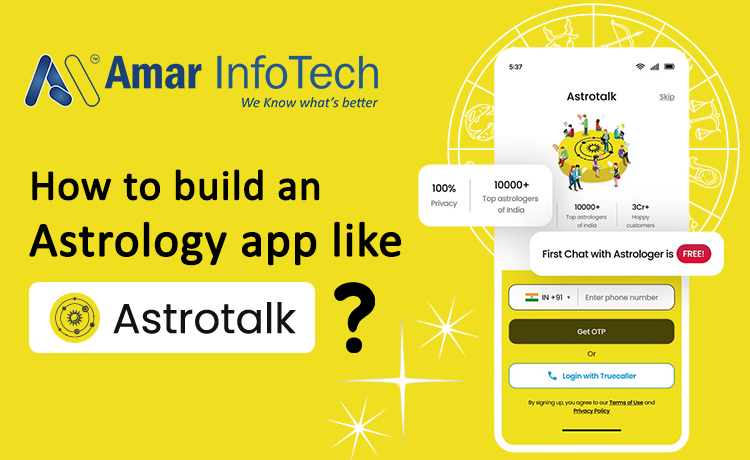




Astrology and horoscope applications now serve one of the fastest-growing segments in consumer technology. AstroTalk, one of the category's most recognisable platforms, offers daily horoscopes, Kundli readings, astrology predictions, and live consultations with professional astrologers.
Organisations exploring this space typically face one of three routes: build the app in-house, licence a white-label astrology platform or API, or commission a specialist astrology app development company. This guide compares all three, outlines the features and technology decisions involved, and explains how mobile app development partners such as Amar Infotech typically structure this type of engagement.
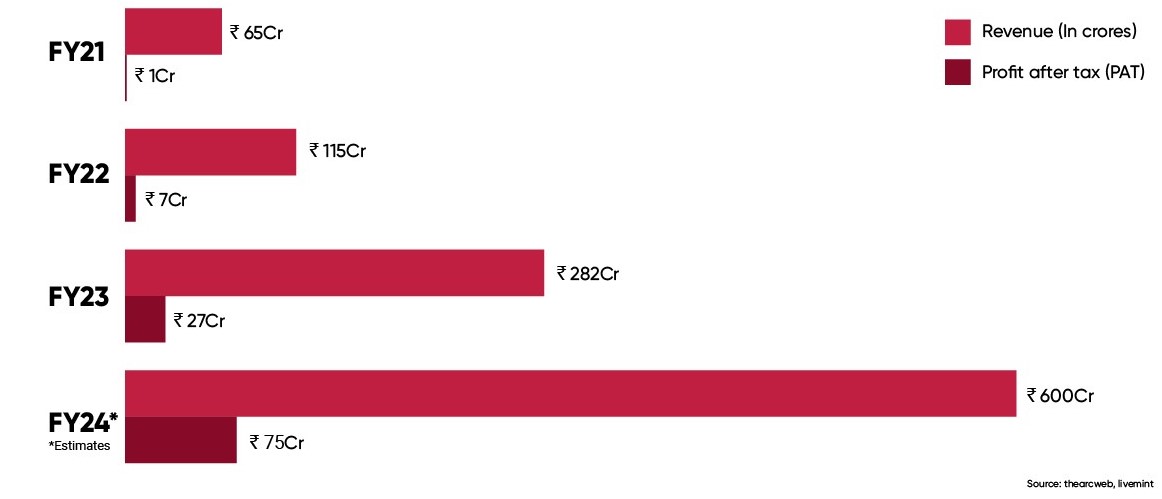
The market opportunity is significant. According to Business Research Insights, the global astrology app market is projected to grow from USD 2,065.33 million in 2021 to approximately USD 23,899 million by 2032. In India specifically, demand for astrology and horoscope apps continues to rise, supported by strong cultural relevance and increasing smartphone penetration.
Why Build an Astrology App?
A well-designed astrology app gives users a convenient way to seek guidance on health, relationships, career, and personal decisions. With the right feature set, it can generate recurring revenue through consultations, subscriptions, and content licensing.
- Rapid Market Growth
- Rising Demand in India
The global astrology app market is expanding at a compound rate few consumer app categories can match, driven by demand for personalised, on-demand guidance.
India remains the largest single market for astrology apps, with strong engagement across Vedic astrology, Kundli matching, and regional-language horoscopes.
Types of Astrology App You Can Build
Before commissioning development, it is worth deciding which astrology discipline or combination your app will focus on, as this affects both the feature set and the data sources required.
Vedic/Indian Astrology
- Based on planetary positions at the time of birth.
- Centres on birth chart (Kundli) generation for predictions.
- Strong cultural relevance across the Indian market.
Western Astrology
- Organised around zodiac (sun) signs rather than full birth charts.
- Zodiac sign is determined by date of birth alone.
- Lower barrier to entry for users unfamiliar with Vedic systems.
Chinese Astrology
- Built around twelve animal signs on a lunar, 12-year cycle.
- Predictions incorporate the lunar calendar and celestial events.
Numerology
- Derives predictions from numbers calculated from a user's birth date.
- Reduces birth dates to a single core digit (for example, 24/12/1995 → 6).
Palmistry
- Interprets lines, marks, and features on the hand, typically via image upload.
- Used to address questions on health, wealth, and relationships.
Tarot Reading
- Relies on a virtual deck shuffled and drawn by the user.
- Well suited to answering specific, situational questions.
Crystal Ball Gazing
- A traditional fortune-telling format, now offered as a guided digital experience.
Astrology App Development Company vs In-House Team vs White-Label Solutions
This is the first decision most founders need to make, and search data shows it is frequently misunderstood. There are three realistic routes to market, each with different cost, control, and speed trade-offs.
- Build In-House
- Licence a White-Label Astrology API
- Commission an Astrology App Development Company
Requires hiring or reassigning developers, astrology data specialists, and QA resources internally. This route offers maximum control but the longest time to market and the highest fixed cost, since ephemeris calculations, house systems, and aspect logic typically take several months to build and validate from scratch.
Providers such as Prokerala Astrology API, Horoscope Services, and Astrology-API.io offer white-label horoscope content, Kundli calculations, and compatibility reports via API, so a team only needs to build the app layer on top. This is faster and cheaper to launch but offers less control over content originality, branding depth, and long-term differentiation, since the underlying astrology logic is shared across every licensee.
A specialist development partner combines custom app engineering with astrology domain experience, giving you a fully branded, differentiated product without the multi-month internal build. This is typically the balance point between the speed of a white-label API and the control of an in-house build, and is the route most funded astrology platforms use once they move past an MVP.
There is no universally "correct" choice a lifestyle brand adding light astrology content for engagement may be well served by a white-label API, while a platform aiming to compete with AstroTalk or Astroyogi on consultations and retention will generally need custom development to support live sessions, payments, and astrologer management at scale.
Top AstroTalk Competitors and Alternatives (2026)
Anyone evaluating this market should understand the existing competitive landscape before finalising a feature list. AstroTalk's closest competitors by traffic and funding include InstaAstro, Astroyogi, AstroSage, and Bodhi, alongside established players such as GaneshaSpeaks and Vinay Bajrangi. Users seeking a more modern, insight-driven interface often compare AstroTalk against global apps such as Nebula, Co-Star, and The Pattern.
| App | Primary Focus | Differentiator |
|---|---|---|
| AstroTalk | Vedic astrology, live consultations | Large astrologer network, chat/call/video |
| Astroyogi | Vedic astrology, on-demand consultations | Long-established brand, high traffic volume |
| AstroSage | Kundli, Vedic calculations, AI features | Strong install base and AI-driven Kundli tools |
| InstaAstro | Live consultations | Positioned as a fast-growing AstroTalk challenger |
| Nebula / Co-Star | Western astrology, personalised insights | Modern UI, appeals to younger global audiences |
Note: traffic and funding figures change frequently in this category. Founders benchmarking a new app should verify current metrics via tools such as Semrush or Tracxn before finalising a business case.
Must-Have Features for an Astrology App
Feature depth is the primary driver of both development cost and user retention. The list below reflects the feature set used by leading platforms such as AstroTalk.
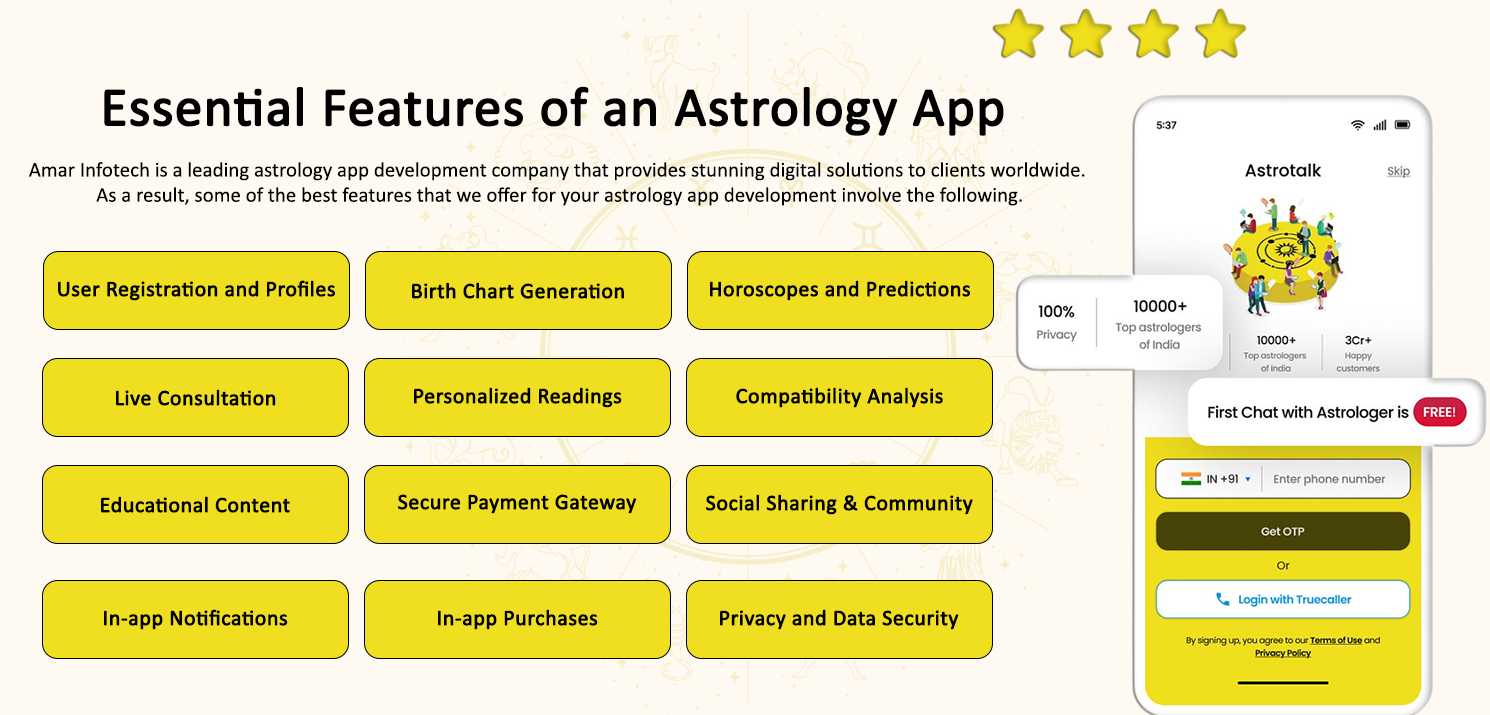
- User Registration and Profiles
- Birth Chart Generation
- Horoscopes and Predictions
- Live Consultation
- Personalised Readings
- Compatibility Analysis
- Educational Content
- Secure Payment Gateway
- Social Sharing and Community
- In-App Notifications
- In-App Purchases
- Help Centre
- Privacy and Data Security
Allows users to register using email or mobile number and stores birth details for personalised results.
👉 Recommended Read:The Evolution of E-commerce: A Historical Perspective and Future Trends
Generates accurate birth charts from date, time, and location of birth, forming the basis for personalised readings.
Delivers daily, weekly, and monthly horoscopes by zodiac sign, covering love, career, and health.
Enables users to book and conduct live chat, audio, or video sessions with astrologers.
Uses custom algorithms to generate detailed readings from a user's unique birth chart.
Compares two birth charts to produce relationship, professional, or family compatibility reports.
Blogs, articles, and reference material on astrology concepts to support engagement and SEO.
Manages subscriptions, in-app purchases, and consultation payments securely.
👉 Trendy Read:Guide For Ecommerce Trends And Future Of ECommerce
Lets users share horoscopes and birth charts on social platforms to drive organic growth.
Push alerts for new horoscopes, astrological events, and personalised reading updates.
Additional revenue stream via premium content or virtual items.
Dedicated support for technical issues and account management.
Encryption and compliance controls to protect sensitive birth and payment data.
Personalisation: Using Birth Chart Data for Push Notifications
One of the highest-leverage features in a modern astrology app is birth-chart-driven personalisation, and it is increasingly relevant beyond astrology apps themselves lifestyle, wellness, and meditation apps are adding astrology-based personalisation to improve engagement.
A well-structured system typically segments users by sun sign, moon sign, and current planetary transits, then triggers notifications aligned to that data for example, a calming or reflection-themed prompt on a day when a user's chart indicates a stressful transit. To support this reliably, the underlying CMS generally needs to store, at minimum:
- Birth data: date, time, and location of birth for chart calculation.
- Derived chart attributes: sun sign, moon sign, rising sign, and dominant planetary placements.
- Notification preferences: frequency, tone (motivational, reflective, cautionary), and opt-in categories.
- Transit calendar mapping: a reference table linking current planetary transits to content themes.
- Engagement history: which notification types a user has opened, to refine future targeting.
This structure allows an app to move from generic daily horoscopes towards genuinely individual content, which is one of the strongest retention levers available in this category.
Content Calendar and Multi-Language Syndication
Astrology content performs best when published on a predictable cadence and tailored to key moments in each user's chart. A practical content calendar typically layers three cycles:
- Daily: love, career, and general horoscope predictions by zodiac sign.
- Weekly: birth-date compatibility highlights and relevant planetary transit summaries.
- Monthly/Yearly: deeper thematic content annual forecasts, retrograde guides, and festival-linked readings.
For platforms operating across multiple markets, this content is typically syndicated across language editions via a central CMS with locale-specific fields, rather than maintained as fully separate content sets. This keeps astrological accuracy consistent while allowing tone, idiom, and cultural references to be localised for example, into Hindi, Tamil, Telugu, or Bengali for the Indian market.
How to Develop an Astrology App Like AstroTalk
Once the build-vs-buy decision and feature list are settled, development typically follows this sequence:
- Conduct Market Research
- Define the Feature List
- Select a Development Partner
- Choose the Technology Stack
- React Native, where 3D or highly interactive chart visualisation is required.
- Flutter, where a highly customised, brand-specific design system is a priority.
- Laravel or Node.js backends, paired with a dedicated astrology calculation engine or third-party ephemeris API.
- Evaluate Platform and Revenue Priorities
- Launch and Iterate
Review competitor appsAstroTalk, Astroyogi, AstroSage, InstaAstro and analyse App Store and Play Store reviews to identify gaps in existing offerings.
Prioritise features such as AI-based palm reading, tarot readings, video consultations, and multi-tier horoscopes based on target audience and budget.
An experienced astrology app development company manages the technical build end-to-end, allowing internal teams to focus on astrologer onboarding, marketing, and growth.
Common stack decisions include:
iOS users typically generate higher average revenue per user, while Android offers a larger addressable audience this balance should inform platform sequencing.
Following release, prioritise analytics on consultation conversion and notification engagement to guide the product roadmap.
How to Monetise an Astrology App
- In-App Purchases
- Subscription Plans
- Paid Live Events
- Affiliate Marketing
Detailed consultations, in-depth reports, or exclusive content sold directly within the app.
Monthly or annual plans unlocking additional astrologers, advanced features, or premium content.
Webinars, workshops, or Q&A sessions hosted by well-known astrologers.
Commission-based partnerships with complementary wellness or lifestyle brands.
Astrology App Development Cost
Development cost depends primarily on feature depth, platform coverage, and integration complexity. Approximate ranges:
- Basic App (daily horoscopes, zodiac details, birth chart calculator): $5,000–$12,000 for a single platform.
- Intermediate App (personalised readings, compatibility analysis, chat/AI bot, multilingual support): $15,000–$30,000.
- Advanced App (live video consultations, AI features, payment integration, admin panel): $35,000–$60,000+.
- White-Label Solutions: from $3,000, depending on customisation depth.
- Cross-Platform Development (iOS and Android): typically 20–40% more than a single-platform build.
- Ongoing Maintenance: varies by update frequency and feature complexity, and should be budgeted for separately from the initial build.
What Affects the Cost of Developing an Astrology App?
- App Complexity: Basic horoscope delivery costs significantly less than personalised birth-chart and compatibility features.
- Feature Set: Each additional module moon phase tracking, tarot, compatibility analysis adds development effort.
- UI/UX Design: Polished, brand-distinct design typically requires greater design investment.
- Data Integration: Connecting reliable astrology databases or APIs adds technical complexity.
- Platform Coverage: Building for iOS, Android, or both affects overall cost.
- Technology Stack: More advanced tooling can improve performance but may increase budget.
- Backend Development: Personalisation and compatibility features require a robust, secure backend.
- Third-Party Integrations: External services such as tarot engines or communication APIs may carry licensing fees.
- Testing and QA: Ensures prediction accuracy and stability across devices.
- Ongoing Maintenance: Required to keep the app compatible with new OS versions and devices.
How Amar Infotech Can Help You Build a Successful Astrology App Like AstroTalk
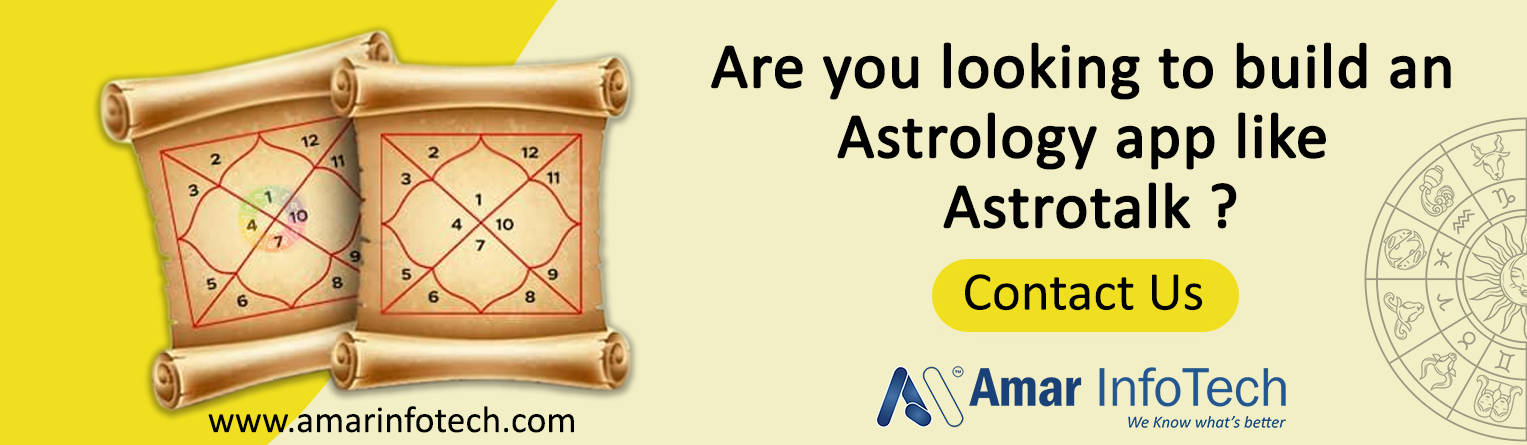
Amar Infotech is an astrology app development company with 15+ years of experience across mobile and web platforms, combining technical delivery with domain understanding of astrology products.
Our iOS and Android development teams have delivered platforms such as Shreeji Astro, a spiritual and astrology guidance platform, and Astro Akashic, which combines astrology with Akashic record readings and live consultations.
We build custom features from AI-assisted palm reading to interactive tarot sessions and birth-chart-based personalisation as either a fully custom build or a structured extension of a white-label foundation, depending on your budget and timeline.
If you are evaluating an astrology app development company, in-house build, or white-label platform for your project, contact Amar Infotech for a free consultation and cost estimate.
Recent Blog

Services
Build Your Agile Team Today..
Inquiry Now