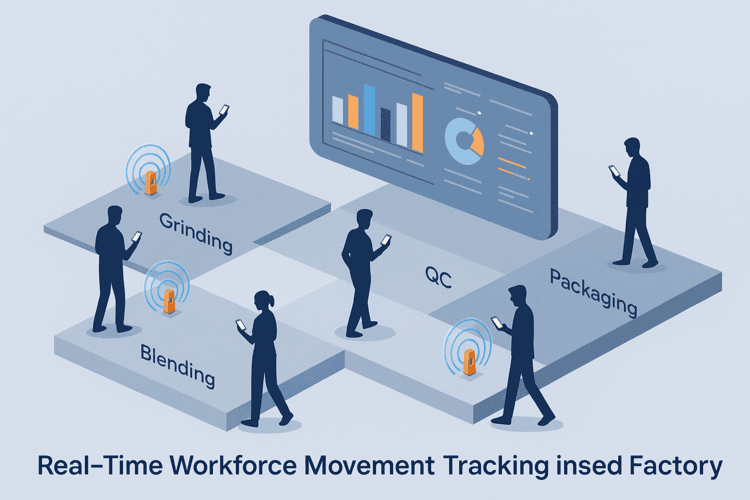


Shankar Masala is one of India's fastest-growing spice brands, producing a wide range of masalas and seasonings distributed globally. Their production facility in Baroda, Gujarat spans multiple zones, from grinding and blending to quality checks and packaging.
As operations scaled, management needed an answer to one question:
"How do we monitor and optimize supervisor movement across factory zones without relying on manual logs or GPS?"
The Core Problem
Factory floors are hard environments for GPS. Thick walls, metal structures and machinery block or degrade satellite signals. At Shankar Masala, management had no reliable way to see which critical zones supervisors actually visited, and the manual system in place lacked accuracy and transparency.
Limitations of the previous approach:
- Manual logbooks were slow to maintain, often inaccurate and open to tampering
- GPS-based staff tracking failed inside the factory because of thick walls, metal obstructions and signal drop
- Supervisors could skip zones unnoticed, which weakened quality-control oversight
- Wearable GPS or RFID systems were too expensive, hard to scale, or needed frequent maintenance
Solution Overview: BLE-Based Proximity Tracking
Amar Infotech designed and deployed a BLE beacon and mobile app system with a Node.js backend for automated, zone-level staff tracking. It was built by our IoT application development team and is used daily by supervisors and plant managers.
Key Deliverables
- Bluetooth Low Energy (BLE) beacons with an 8-10 ft detection range
- No manual check-in or RFID swipe
- A mobile app that runs in the background on the supervisor's smartphone
- Automatic logging of entry, exit and time spent in each production zone
- Real-time data sent to a central dashboard built on a Node.js backend
Technical Architecture
The system uses scalable, modern components that non-technical factory staff can use without training. Here is how the parts work together to deliver real-time indoor location tracking.
BLE beacons (installed hardware)
- Battery-powered, with a 3-4 year lifespan
- Mounted at key locations in each zone
- Short range (8-10 ft) for zone-accurate detection
- Dust and humidity resistant (IP65)
Mobile app (for supervisors)
- Lightweight and runs in the background
- Detects nearby beacons over Bluetooth
- Logs entry and exit automatically, with no manual action
- Available on Android and iOS
Backend (Node.js + Express)
The backend receives real-time detection events, stores secure time-series logs, and supports queries for reports, analytics and AI applications.
- Real-time data logging and sync
- Secure storage of logs
- Time-series structure for analytics
Dashboard (for plant managers)
A web dashboard gives plant managers a clear view of daily activity, so they can make faster decisions, audit shifts and spend less time on admin.
- Live zone tracking
- Performance summaries per supervisor
- Alerts for skipped zones
- Downloadable reports (CSV/PDF)
How Zone Detection Works
Each beacon broadcasts a small identifier signal. The app estimates how close the phone is from the strength of that signal (RSSI) and logs a zone visit when the supervisor stays within range. Signal strength fluctuates indoors, so the app smooths readings and applies a minimum time in range, which stops a brief pass-by from being recorded as a full visit.
Watch: Plant Worker & Supervisor Movement Tracking
Impact After Deployment
BLE proximity tracking improved shift tracking, productivity analysis and operations oversight right away. Results below were measured over.
| Metric | Before (manual logs) | After (BLE system) |
|---|---|---|
| Supervisor check accuracy | About 60% | 100% of zone visits automatically recorded |
| Manual log errors | Frequent | Eliminated (no manual logging) |
| Admin time for shift reports | 2-3 hours of manual compilation | Instant, automated reports |
| Missed-zone detection | Manual review after the fact | Real-time alerts |
Why BLE Works Where GPS Fails
Manufacturing plants are typically GPS dead zones because of their construction materials and layout. BLE is built for short-range indoor use and works well where GPS cannot.
- GPS fails indoors because walls, machinery and metal block the signal, and even outdoors a phone is typically accurate only to around 5 m
- BLE uses short-range wireless, which suits factory environments
- BLE beacons are battery-operated and need no wiring or mains power
- BLE supports zone-level tracking that GPS cannot deliver indoors
Can a Supervisor Game a Phone-Based System?
Manual logs were open to tampering, so any replacement has to be tested against the obvious workaround: leaving a phone in a zone while the supervisor is elsewhere. A phone-based BLE system needs safeguards beyond simple detection. Common ones include:
- Minimum dwell time before a visit counts
- Motion checks using the phone's sensors, to flag a device that has not moved for hours
- Multiple beacons per large zone, so presence is confirmed from more than one signal
- Login-bound devices, so each phone is tied to one named supervisor
- Anomaly flags for visits that look implausible, such as two distant zones logged minutes apart
Newer Bluetooth features also help with this problem, as the next section explains.
Do You Need Bluetooth 6.0 Channel Sounding?
Bluetooth has moved on since this system was designed. Core Specification 6.0 arrived in September 2024 with Channel Sounding, a method for two Bluetooth devices to measure the distance between them far more accurately than signal-strength methods. Version 6.1 followed in May 2025, 6.2 in November 2025 (adding resilience against ranging attacks), and 6.3 in May 2026. See the Bluetooth SIG's Core 6.0 feature overview and this developer summary of releases since 6.0.
Accuracy improves from roughly 3-5 metres with signal strength to around 30-50 centimetres, and early implementations report about ±20 cm. It needs new Bluetooth hardware, and factory radio environments are still difficult, so treat "centimetre-level" as a best case.
For zone-level supervisor presence, standard BLE beacons are enough. Channel Sounding becomes worthwhile when you need machine-level positioning, precise distance rules (for example, "operator within 2 m of the line"), or stronger protection against spoofing.
| Technology | Typical accuracy | Infrastructure | Best for |
|---|---|---|---|
| BLE beacons (RSSI) | Zone or room level | Battery beacons, no wiring | Presence and dwell-time logging |
| BLE Channel Sounding (Bluetooth 6.0+) | Tens of centimetres | New compatible hardware | Fine ranging, secure proximity |
| UWB | Centimetre to decimetre | Anchors and powered infrastructure | Precise real-time positioning |
| RFID | Checkpoint (gate) level | Readers plus tags or badges | Entry and exit control |
| GPS | Metres, outdoors only | None on site | Yards, fleets, outdoor assets |
Employee Location Tracking and India's DPDP Rules
Location logs tied to named employees are personal data. India's Digital Personal Data Protection Rules were notified on 13 November 2025, and most day-to-day obligations for employers (notices, consent handling, breach reporting and individual rights) become enforceable during an 18-month phase-in, with full compliance due by mid-May 2027. Penalties can reach ₹250 crore for failing to maintain reasonable security safeguards.
Good design practice for a tracking system like this one:
- Purpose limitation: use the data for quality oversight and shift audits, and say so in writing
- Clear notice to employees about what is logged, when and why
- Retention limits: keep logs only as long as the stated purpose needs them
- Access control: role-based access to reports and exports
- Breach readiness: a documented response process, since the Rules require prompt reporting
This is general information, not legal advice. Confirm your obligations with qualified counsel.
12 Industrial Use Cases Beyond Supervisor Monitoring
The same BLE proximity approach supports automated audits, compliance checks, better worker allocation and analytics in any factory where GPS tracking fails.
- Supervisor zone-wise presence logging: track supervisor movement in each production area for accountability and traceability
- Time and attendance automation: replace punch cards and manual logbooks with automatic proximity-based logs
- Operator-machine presence validation: confirm the right operator is at the right machine during operating hours
- Contractor and visitor movement tracking: monitor short-term visitors and maintenance staff without ID badges or escorts
- Assembly line productivity analysis: measure time spent at each station and spot workflow bottlenecks
- Restricted zone compliance: log only authorized personnel in hazardous or sterile areas
- Emergency and evacuation audit: see the last-known location of staff during a fire or evacuation
- Packaging and dispatch monitoring: track staff presence where timing affects shipping and inventory
- Cleanroom entry monitoring: log presence in temperature- or contamination-sensitive areas of food and pharmaceutical plants
- Shift changeover monitoring: confirm handoffs and safety briefings during shift overlaps
- Workforce heatmaps and zone utilization: see which areas are visited most and surface anomalies
- Audit-ready presence records: keep a workforce audit trail without GPS or RFID infrastructure, useful as supporting evidence for food-safety inspections (check what your certification body requires)
Rollout Approach
A staged rollout keeps risk low for a plant that cannot stop production:
- Site survey and zone mapping: decide which areas need coverage and where beacons go
- Pilot in two or three zones: calibrate detection range and dwell-time rules on real shifts
- Full deployment: extend to all zones once pilot accuracy is confirmed
- Training and review: brief supervisors and plant managers, then review the first weeks of reports together
AI-Ready Analytics for Factory Operations
BLE proximity logs are structured, time-stamped data, which makes them a good input for AI and analytics tools. Beyond standard reports, the data can support:
- Natural language queries, such as "Who missed the QC zone yesterday?"
- Auto-generated daily or weekly shift reports
- Anomaly detection on time spent in each zone
- Integration with HRMS and ERP systems to link presence data with attendance, payroll and performance
- Predictive analytics on zone visits and movement patterns to spot inefficiencies or risks in workforce deployment
- Alerts and answers delivered through chat channels such as WhatsApp or Teams
Example questions a plant manager could ask:
- "Show supervisor time logs for the packaging zone last week"
- "Alert me if no one visits quality control for 30 minutes"
- "Download the visit report for Shift A on June 15"
- "Who skipped the dispatch zone today?"
Our AI and ML development team can add these capabilities to an existing BLE deployment, and our industrial IoT solutions cover the wider plant-floor data pipeline.
Client Testimonial
Implementing Amar Infotech's BLE-based proximity tracking system transformed how we manage our factory floor. What used to take hours now takes minutes. We finally have real-time, accurate insights into where our supervisors are, and when. No more guesswork or manual logs, just clean, automated tracking. It's increased accountability and made our operations smoother than ever.
Operations Head, Shankar Masala Production Plant
Conclusion
This BLE-based system replaced unreliable manual tracking with an accurate, scalable solution that needs no GPS, wearables or wired infrastructure. It gives plant managers visibility, saves admin time, improves supervisor accountability and creates a data foundation for AI-powered optimization. As Bluetooth 6.x hardware matures, the same architecture can add finer ranging where it pays off, and clear privacy practices keep it aligned with India's DPDP requirements.