



Why Indoor Workforce Tracking Matters for Smart Factories Now
Factories in India have automated rapidly over the past decade. Machines, production lines and supply chains are increasingly data-driven, yet one input is still recorded with outdated tools: where people are inside the plant.
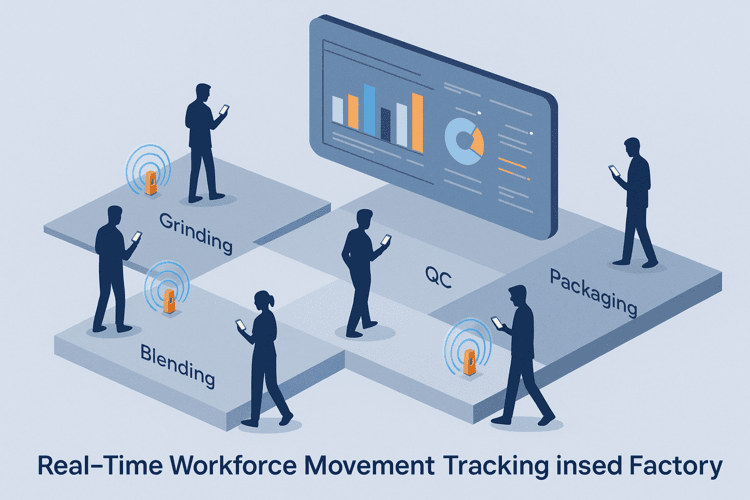
Indoor workforce tracking closes that gap. It records which zones supervisors and workers visit, and for how long, without swipes, signatures or manual logbooks. That zone-level visibility directly affects productivity, quality and safety.
The market is moving in the same direction. MarketsandMarkets estimates the global indoor location market at $11.9 billion in 2024, growing to $31.4 billion by 2029 (a 21.4% CAGR). In India, P&S Intelligence values the smart factory market at $7.7 billion in 2025, rising to $17.0 billion by 2032. Analyst estimates vary widely with how each publisher defines the market, so treat these as directional.
Regulation is shifting too. India's Occupational Safety, Health and Working Conditions (OSH) Code came into force on 21 November 2025, and the Digital Personal Data Protection (DPDP) Rules require full compliance by 13 May 2027. Factories now need tracking that is accountable to the shop floor and privacy-conscious towards employees.
Why Traditional Methods Are No Longer Enough
For years, factories relied on three approaches to track workforce movement: GPS, RFID or swipe systems, and manual logbooks. Each has clear limits in a modern industrial setting.
GPS Fails Indoors
GPS works well outdoors for vehicles and field staff. Inside a plant, thick walls, metal structures and heavy machinery block or reflect satellite signals, so positions are too unreliable to confirm a visit to a specific zone.
RFID and Swipe Systems Depend on Human Action
Swipe cards and RFID checkpoints need a deliberate action every time. Cards can be shared, readers can fail, and maintenance costs add up. These systems also cannot provide continuous, automatic zone-level presence.
Manual Logbooks Are Error-Prone
Many plants still use paper logbooks for supervisor rounds and checks. They waste time, invite errors and can be altered after the fact. Managers often spend hours compiling reports from incomplete entries.
Result: missed checks, weak accountability, wasted administrative hours and no real-time insight.
Inside Tracking vs Outside Tracking
Many businesses already invest in outside tracking: GPS for delivery fleets, field sales and logistics. Those systems improve logistics efficiency, but they do not improve what happens on the factory floor.
- Outside tracking: logistics efficiency and fleet visibility.
- Inside tracking: factory performance, quality and safety.
Attendance systems show who entered the facility. They cannot show whether a supervisor actually visited the QC zone, or whether staff were present in packaging during peak hours. Zone-level visibility is the missing piece for operational control.
How BLE Indoor Workforce Tracking Works
The current generation of solutions combines Bluetooth Low Energy (BLE) beacons, a background mobile app or wearable tag, a scalable backend and a manager dashboard. Together they deliver continuous zone-level presence without manual check-ins.
Key Components
- BLE Beacons: Small, battery-powered, industrial-grade devices (dust and humidity resistant) installed across production zones such as Grinding, Blending, QC and Packaging. Range is configurable through transmit power. For example, it can be tuned to roughly 8–10 ft so that neighbouring zones do not overlap. Battery life is typically several years, depending on advertising interval and transmit power.
- Supervisor Mobile App: An Android or iOS app running in the background that detects beacons automatically and logs entry, exit and duration per zone. Our IoT application development team builds these apps for BLE, iBeacon and geo-fencing use cases.
- Backend (Node.js + Express): Receives real-time events, stores secure time-series logs and exposes APIs for reporting and ERP or HRMS integration.
- Manager Dashboard (Angular / Next.js): Visualises live movement and zone coverage, raises alerts and produces downloadable CSV and PDF reports.
- Deployment: Cloud or on-premise, chosen to suit the plant's IT policy and network conditions.
This architecture delivers dependable indoor presence data where GPS cannot operate, so managers can act on accurate, timely information.
BLE, Channel Sounding, UWB or RFID: Choosing the Right Technology
No single technology suits every zone. The right choice depends on the precision you need, the cost per zone and the battery life you can accept.
| Technology | Typical precision | Best suited to | Trade-off |
|---|---|---|---|
| BLE beacons (RSSI) | Zone or room level | Supervisor rounds, zone-wise attendance, coverage reports | Not designed for exact coordinates |
| BLE Channel Sounding (Bluetooth 6.0) | Tens of centimetres on compatible hardware | Zones needing finer proximity, such as machine-level validation | Needs compatible chipsets on both devices |
| UWB | Centimetre to sub-centimetre | Safety-critical or high-precision tasks | Higher cost and infrastructure |
| RFID and NFC | Fixed checkpoint | Access control and checkpoint validation | Needs a deliberate action at each point |
| LoRaWAN | Campus-scale coverage | Large campuses and outdoor yards | Not for fine indoor positioning |
| Wi-Fi and ZigBee | Room to several metres | Plants with established IT networks | Depends on existing network design |
What Bluetooth 6.0 Channel Sounding Changes
Bluetooth Core 6.0, announced in 2024, introduced Channel Sounding for secure distance measurement. Embedded.com reports accuracy of around ±20 cm in early implementations, although results depend on hardware and environment. The Bluetooth SIG notes that UWB combined with time-of-flight measurement is still the option for higher, centimetre to sub-centimetre precision.
Channel Sounding needs compatible chipsets on both ends, so an existing beacon estate will not gain it through a software update alone. For most zone-based supervisor tracking, standard BLE remains sufficient. We recommend adding higher-precision technologies only where a specific use case justifies the cost.
Phone-Based or Badge-Based Tracking?
- Phone-based (supervisor app): Low hardware cost and uses devices staff already carry. Constraints include operating-system limits on background scanning, battery optimisation settings and phone restrictions in some hazardous zones.
- Badge or tag-based: A wearable tag that fixed gateways detect. It works for workers without smartphones, contractors and visitors, but needs gateways and tag lifecycle management.
We usually decide between the two after a site survey, and many plants use a mix.
Key Benefits for Factories
- Zone-Wise Accountability: Every supervisor visit and its duration is logged automatically, and skipped zones are detected instantly.
- Operational Efficiency: Visibility into where time is spent helps identify bottlenecks and optimise staffing.
- Safety and Compliance: Restricted zones can be monitored in real time, unauthorised entry triggers alerts, and evacuation audits can use last-known zones.
- Automated Attendance and Shift Reporting: Instant reports replace logbooks and punch cards.
- AI-Ready Analytics: Structured time-series data supports anomaly detection, prediction and natural-language reporting.
Privacy and Compliance: DPDP Rules and the OSH Code
Location data about employees is personal data, so tracking has to be designed with privacy in mind. This section is general information and not legal advice, so confirm your legal basis with counsel.
India's DPDP Rules
The DPDP Rules were notified on 13 November 2025 and are being rolled out in phases. The Data Protection Board provisions are already in force, consent-manager provisions apply from 13 November 2026, and the remaining obligations on consent, notices and rights apply from 13 May 2027. Penalties can reach ₹250 crore for failing to maintain reasonable security safeguards. Commentary also indicates that a personal data breach requires a detailed report to the Board within 72 hours.
The OSH Code
The Labour Codes took effect on 21 November 2025. The OSH Code consolidates 13 earlier laws, including the Factories Act, 1948, and covers establishments with ten or more workers. It places a general duty on employers to keep the workplace free from hazards. Zone-level data on restricted-area entry and evacuation audits can support that duty. Employers should check the current status of central and state rules for their location.
Privacy-by-Design Practices
- Data Minimisation: Log zone entry, exit and duration rather than continuous coordinates.
- Defined Scope: Track during working hours only, and limit tracking to the roles that need it.
- Clear Notice: Tell employees what is collected, why and for how long.
- Security Safeguards: Use encryption, role-based access and audit logs.
- Retention Limits: Delete or anonymise data once its purpose is served.
- Breach Readiness: Keep a documented incident-response and reporting process.
Securing the Beacon Network
A tracking system is only as trustworthy as its data. Fixed beacon identifiers can be cloned, which would allow a supervisor to appear present in a zone they never visited.
- Secure Device Provisioning: Authenticated onboarding and lifecycle management of every beacon and gateway.
- Rotating or Signed Identifiers: Reduce the risk of spoofing and cloning.
- Tamper and Health Alerts: Flag moved, removed or offline beacons and low batteries.
- OTA Updates: Over-the-air firmware upgrades keep security patches current with minimal downtime.
Integrating Workforce Data with ERP, HRMS and MES
To get the most from real-time workforce tracking, forward-looking manufacturers extend the data flow into their ERP systems. Zone-wise attendance, supervisor presence and compliance checks then sync with production planning, payroll and performance metrics.
At Amar Infotech, we specialise in IoT-enabled ERP development in India. We combine the precision of BLE tracking with the intelligence of ERP analytics. Think of it as moving from "Where is my supervisor?" to "How does this movement improve my bottom line?"
- ERP and HRMS Integration: Link zone time to payroll for accurate, attendance-based compensation.
- MES and Production Data: Correlate supervisor presence with quality checks and line performance.
- Heatmaps and Digital Twins: Visualise high-traffic zones to optimise layouts, staffing and workflows.
Generative AI and Conversational Analytics
Large language model (LLM) assistants can turn raw tracking data into insight through natural language. Because the underlying data is structured, answers can be traced back to logged events rather than guessed.
- Chat-Based Queries: Managers can ask "Who skipped QC yesterday?" or "Show supervisor visits to Packaging last week" and receive a clear answer.
- AI-Generated Reports: Daily or weekly summaries can be created automatically for review or distribution.
- Voice and Chat Interfaces: Access data hands-free on the shop floor through voice assistants or chat platforms.
- Multilingual Support: English, Hindi and Gujarati queries make analytics accessible to local supervisors and managers.
- Anomaly Detection: Machine learning can flag unusual patterns, such as repeatedly skipped zones or unexpected after-hours presence.
Guardrails matter. Apply role-based access to any AI assistant, and control how personal data reaches third-party models to stay aligned with DPDP obligations.
Cost, ROI and a Practical Pilot Roadmap
The cost of a workforce tracking system depends on the number of zones, the count of beacons or gateways, the level of integration and any custom firmware. Rather than digitising the whole plant at once, we recommend a focused pilot on one line or two to three zones.
- Site Survey and Zone Mapping: Identify zones, interference sources and the phone or badge approach.
- Baseline: Record current round-completion rates, missed checks and reporting effort.
- Pilot Deployment: Install beacons, configure the app and dashboard, and train supervisors.
- Measure: Compare results against the baseline.
- Scale and Integrate: Extend to further zones and connect ERP or HRMS.
Useful metrics include supervisor round completion, missed QC checks, time spent per zone, report compilation time, restricted-zone alerts and evacuation muster time.
Case Studies and Real-World Examples
Illustrative Scenario: Automotive Parts Manufacturer (Maharashtra)
A mid-sized automotive supplier faced inconsistent supervisor presence and missed QC checks. Manual logbooks were unreliable, and RFID was too expensive to roll out across multiple units.
- Solution: Amar Infotech deployed BLE beacons in critical zones, installed a background supervisor app and implemented a Node.js backend with a real-time dashboard.
- Outcome: Supervisor compliance rose from 55% to 100% [UNVERIFIED], missed QC checks fell by 90% [UNVERIFIED], and daily reporting time dropped from 3 hours to instant automated reports [UNVERIFIED].
Explore our automotive IoT solutions for related work.
Real Example: Shankar Masala, Vadodara (Baroda)
Shankar Masala, a fast-growing spice manufacturer in Vadodara (Baroda), improved supervisor accountability and reporting using BLE proximity tracking. Manual logs and GPS had failed to provide reliable zone-level presence.
Read the detailed case study:BLE Proximity Tracking at Shankar Masala
Where Else Zone-Level Tracking Helps
- Pharmaceuticals: Audit trails showing who entered controlled areas and when.
- Food Processing: Confirming hygiene and QC rounds across production zones.
- Contractors and Visitors: Monitoring short-term staff without physical ID badges.
- Operator-Machine Validation: Ensuring the right operator is at the correct machine for compliance and audit trails.
- Emergency Response: Using last-known zones for faster evacuation audits and safety drills.
Amar Infotech's Technical Expertise
We evaluate each factory's requirements and apply the right communication technology, from industrial IoT development through to mobile apps, web dashboards, ERP integration and AI analytics.
- BLE (Bluetooth Low Energy): Cost-effective zone-wise presence tracking with multi-year battery life.
- RFID and NFC: Access control, checkpoint validation and attendance where fixed checkpoints are preferred.
- UWB (Ultra-Wideband): Centimetre-level accuracy for safety-critical or high-precision requirements.
- LoRaWAN: Long-range, low-power communication for large campuses and outdoor yards.
- Wi-Fi and ZigBee: Integration-friendly options for factories with established IT networks.
Firmware and Core Engineering Depth
- Custom Firmware Development: Firmware for beacons and gateways tuned for low latency, extended battery life and harsh environments.
- Low-Level Protocol Tuning: Tuning BLE, UWB and LoRa parameters for plant-specific interference and layout challenges.
- Secure Device Provisioning: Secure onboarding, authentication and lifecycle management with remote diagnostics.
- Edge Processing: Gateways that filter, buffer and pre-process events to reduce backend load and improve resilience.
- OTA Updates: Over-the-air upgrades that minimise downtime and simplify long-term maintenance.
This firmware-first approach keeps the solution reliable and scalable in real factory conditions, where plug-and-play hardware often fails.
Emerging Trends to Watch
- Precision BLE: Channel Sounding narrows the gap between BLE and UWB for many use cases.
- Sensor Fusion: Combining BLE for zones with UWB where precision matters.
- Edge-First Architectures: Processing closer to the shop floor for resilience and lower latency.
- AI Assistants and Agents: Natural-language reporting, anomaly detection and automated follow-up.
- Privacy-by-Design: DPDP compliance is becoming a buying criterion, not an afterthought.
- Safety-Driven Adoption: The OSH Code raises the importance of provable hazard control and audit trails.
QTrace - Smart IoT Tracking Anytime Anywhere: While Amar Infotech enables zone-wise workforce monitoring inside factories, end-to-end visibility often requires tracking beyond the shop floor. QTrace offers smart IoT-based tracking for logistics, supply chain and on-field operations. Combined with indoor workforce tracking, it gives enterprises a 360° view of their people, processes and productivity.
Conclusion
Indoor workforce tracking is a critical enabler for modern smart factories. It closes the visibility gap left by attendance systems and GPS, delivers zone-level accountability, improves quality and safety, and saves significant administrative effort through automation. Done well, it also respects employee privacy under India's DPDP framework.
Amar Infotech combines BLE hardware, mobile applications, scalable backends, firmware engineering, multi-technology expertise and AI integration to deliver industrial-grade solutions. They work reliably in Gujarat, Maharashtra and across India.
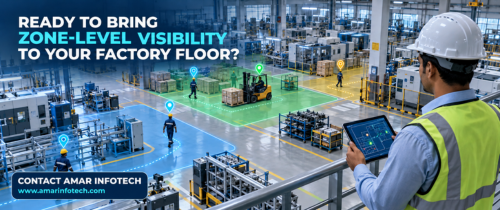
Ready to bring zone-level visibility to your factory floor?Contact Amar Infotech to discuss a pilot for your plant.
Recent Blog
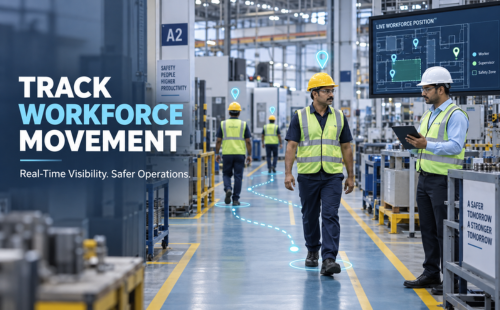
How to Track Plant Worker & Supervisor Movement in Factories
How Vibration and Thermal Predictive Analytics Reduce Unplanned Downtime

Building Proof of Concept (POC) Using MQTT Protocol
Use of Bluetooth Beacon Technology in Smart Airport (More)
Location-based Marketing Geo-fencing vs Geo-targeting vs Beacons (More)
Services
Build Your Agile Team Today..
Inquiry Now