



The global financial ecosystem continues to evolve at an unprecedented pace, driven by the convergence of artificial intelligence, blockchain, open banking, and embedded finance. The term FinTech coined from the integration of technology and finance has matured far beyond digital payments. In 2026, it now encompasses AI-driven advisory, decentralised finance (DeFi), real-time cross-border settlements, and hyper-personalised banking experiences. According to Statista, the global FinTech market is projected to exceed $1.15 trillion by 2032 [UNVERIFIED], with compound annual growth rates consistently above 16%. For entrepreneurs and start-ups, the window of opportunity is wider than ever.
Enterprise investors, financial institutions, and technology-first start-ups are collectively channelling billions into FinTech innovation. Whether you are a founder exploring a new venture or a financial company undergoing digital transformation, understanding the most viable and forward-looking FinTech app ideas for 2026 is essential. Below, we detail the top 12 ideas positioned to dominate the coming years along with key features, market context, and development considerations. If you are ready to build, our mobile app development team at Amar InfoTech is here to guide you from concept to launch.
What Is a Financial App in 2026?
A financial application in 2026 is no longer a simple transaction interface it is an intelligent, integrated platform that manages, predicts, and automates a user's complete financial life. Powered by generative AI, machine learning, open banking APIs, and real-time data processing, modern FinTech apps offer everything from automated tax filing to AI-driven investment rebalancing all accessible from a single mobile interface.
Cloud-native infrastructure, embedded finance capabilities, and regulatory-compliant architecture are now the baseline expectations. FinTech apps are evolving into financial operating systems serving both individual consumers and large enterprises with equal precision and scalability.
In 2026, the core demands shaping FinTech app development include:
AI-First Personalisation : Users expect apps to proactively suggest financial actions not merely report on past transactions. Generative AI and predictive analytics now power intelligent financial nudges, goal tracking, and dynamic budgeting in real time.
Embedded Finance : Non-financial platforms from e-commerce to healthcare are embedding banking, lending, and insurance directly into their user journeys. FinTech solutions must support seamless API-based integration with diverse digital ecosystems.
Regulatory Technology (RegTech) : With evolving compliance mandates across jurisdictions including PSD3 in Europe, RBI guidelines in India, and expanding AML/KYC standards globally FinTech apps must include built-in compliance automation and audit trail capabilities.
Open Banking & Interoperability : APIs enabling real-time data sharing between banks, lenders, and third-party providers are now a standard expectation, not a premium feature. Apps must be built for open banking frameworks from the ground up.
Biometric and Decentralised Security : Advanced multi-factor authentication, behavioural biometrics, and zero-trust security architectures are now fundamental for protecting user data and financial assets in an increasingly threat-saturated environment.
Sustainable Finance Features : ESG (Environmental, Social, Governance) investing tools and carbon footprint trackers have become a key differentiator for apps targeting younger, socially conscious users a fast-growing demographic in 2026.
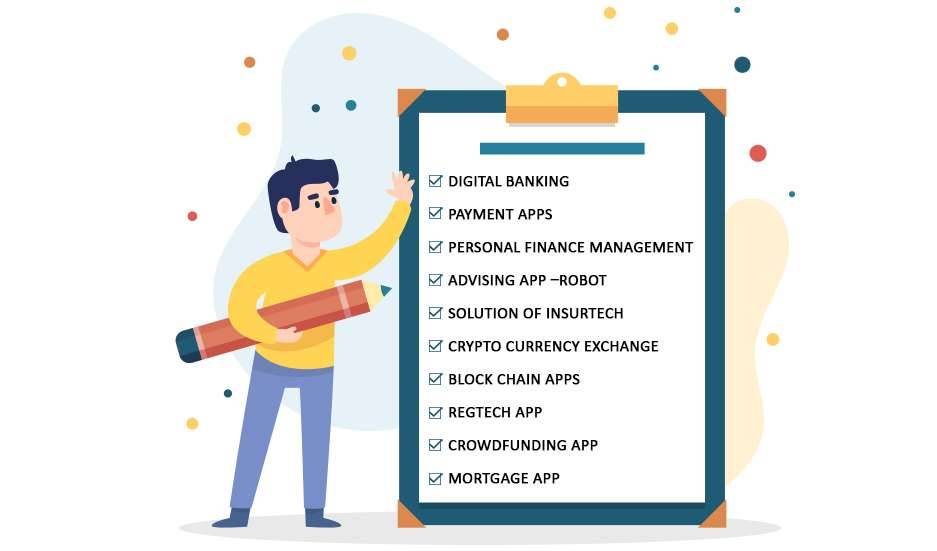
Top 12 FinTech App Ideas for Start-Ups in 2026
- Multi-bank account aggregation via open banking APIs
- AI-driven spending predictions and anomaly alerts
- Automated tax-saving recommendations
- Real-time goal tracking with adaptive budgeting
- ESG spending insights and carbon footprint reports
1. AI-Powered Personal Finance Management App
Personal finance management (PFM) has evolved significantly. In 2026, a PFM app is not merely a budgeting tool it is an AI-powered financial coach that learns user behaviour, predicts future expenditure, and proactively guides users towards healthier financial outcomes. Integration with AI development services enables truly intelligent personal finance experiences.
- Smart contract-based lending and borrowing
- Multi-chain wallet support (Ethereum, Solana, Polygon, etc.)
- Yield optimisation algorithms
- On-chain KYC and compliance modules
- Real-time liquidity pool management
2. Decentralised Finance (DeFi) Platform
DeFi has moved beyond early adopters and is now entering mainstream financial services. A DeFi platform in 2026 connects users to decentralised lending, staking, yield farming, and insurance entirely without traditional intermediaries. Regulatory clarity across major markets has made DeFi platforms increasingly viable for institutional and retail users alike.
The core advantage of a DeFi platform is removing counterparty risk and offering users full custody of their assets while maintaining accessibility.
- Real-time multi-currency conversion with live FX rates
- Stablecoin-based settlement for fee minimisation
- AI-driven fraud detection and transaction monitoring
- Instant recipient notifications and delivery confirmations
- Compliance with FATF guidelines and local remittance regulations
3. Cross-Border Payments & Remittance App
Global remittance flows exceeded $860 billion in 2023 (World Bank) [UNVERIFIED], with traditional transfer fees consuming up to 6% of transaction value. In 2026, blockchain-powered remittance apps using stablecoins and ISO 20022-compliant messaging are disrupting legacy wire transfer systems by offering near-instant, low-fee cross-border settlements.
This category continues to attract significant venture funding and serves a massive underbanked population across South Asia, Africa, and Latin America.
- AI-generated portfolio recommendations based on real-time market data
- ESG and thematic investment screening
- Automated tax-loss harvesting
- Natural language financial query interface (AI chatbot)
- Integration with global exchanges and alternative assets
4. AI-Driven Investment & Robo-Advisory App
Investment apps in 2026 leverage generative AI and large language models (LLMs) to deliver contextual, real-time investment guidance previously available only to high-net-worth individuals. The distinction between traditional investment apps and robo-advisors has largely merged into a unified AI-first advisory experience.
With fractional investing now standard and regulatory sandboxes enabling broader access, this remains one of the highest-growth FinTech categories for 2026.
- Virtual account issuance and IBAN management
- White-label debit/credit card programmes
- Real-time payment rails (UPI, SEPA, FedNow)
- Modular KYC and AML compliance engine
- Developer-friendly REST API documentation and sandbox environment
5. Embedded Banking-as-a-Service (BaaS) Platform
Banking-as-a-Service (BaaS) has become the infrastructure powering the next generation of FinTech products. A BaaS platform enables any business retail, healthcare, logistics to embed regulated financial services (accounts, cards, loans) into their own applications via APIs, without requiring a full banking licence.
- Support for CBDCs, stablecoins, and regulated tokenised assets
- Portfolio tracking across centralised and decentralised exchanges
- Advanced charting, alerts, and AI-assisted trading signals
- Tax reporting automation for digital asset gains
- Institutional-grade cold storage and multi-signature wallet support
6. Cryptocurrency & Digital Asset Management App
The cryptocurrency landscape in 2026 includes Central Bank Digital Currencies (CBDCs), tokenised real-world assets (RWA), and regulated digital securities far beyond the speculative trading origins of the sector. A modern digital asset management app must handle this complexity while delivering a seamless user experience.
Regulatory developments across the EU (MiCA), UK, UAE, and India have brought much-needed clarity, making this a significantly more viable market for new entrants in 2026.
- Conversational AI powered by LLMs with financial domain fine-tuning
- Personalised retirement, insurance, and investment planning
- Debt repayment strategy modelling
- Scenario simulation for major life events (home purchase, education, etc.)
- Integration with live market data and open banking feeds
7. AI-Powered Virtual Financial Adviser
With generative AI reaching conversational maturity, virtual financial advisers in 2026 can deliver nuanced, context-aware financial guidance at scale. These platforms serve individuals who are underserved by traditional wealth management and seek affordable, always-available financial counsel.
The virtual adviser market is projected to manage over $6 trillion in assets by 2027 [UNVERIFIED], driven largely by AI capability improvements and growing user trust.
- Real-time creditworthiness assessment using alternative data
- Merchant integration via SDK and payment gateway plugins
- Flexible repayment scheduling with automated reminders
- B2B instalment financing for SME procurement
- Regulatory-compliant credit reporting to bureaus
8. Buy Now, Pay Later (BNPL) 2.0 Platform
The first generation of BNPL faced regulatory scrutiny globally due to concerns around over-indebtedness. BNPL 2.0 in 2026 addresses these issues head-on with responsible lending frameworks, credit scoring integration, and transparent fee structures while expanding into B2B trade finance and healthcare payments.
- Alternative credit scoring using GST, e-invoicing, and bank statement data
- Automated loan origination and underwriting
- Invoice discounting and revenue-based financing modules
- Integration with accounting platforms (Tally, Zoho Books, QuickBooks)
- Disbursement in under 24 hours via automated decisioning
9. SME Lending & Working Capital Platform
Small and medium enterprises remain significantly underserved by traditional banking credit. AI-powered SME lending platforms in 2026 use alternative data sources GST returns, UPI transaction history, accounting software data to offer rapid, collateral-free working capital loans to businesses that previously lacked access.
India, Southeast Asia, and Africa represent particularly high-growth markets for SME digital lending in 2026.
- Automated KYC with biometric verification and document AI
- Real-time AML transaction monitoring and suspicious activity flagging
- Regulatory change tracking and compliance calendar
- Multi-jurisdiction reporting module (RBI, FCA, SEC, FINMA)
- Audit trail and evidence management for regulatory inspections
10. RegTech & Compliance Automation App
As regulatory requirements across FinTech, banking, and insurance become increasingly complex, dedicated RegTech applications are in high demand. These platforms automate KYC/AML screening, regulatory reporting, transaction monitoring, and audit readiness reducing compliance costs by up to 70% compared to manual processes [UNVERIFIED].
- ESG scoring engine with real-time company sustainability data
- Green bond and impact investment marketplace
- Carbon offset tracking and offsetting recommendations
- Personalised sustainability profile and portfolio alignment score
- Integration with third-party ESG data providers (MSCI, Sustainalytics)
11. Green Finance & ESG Investment Platform
Sustainability-linked investing has moved from niche to mainstream. ESG and green finance platforms in 2026 allow users to align their portfolios with environmental and social values, invest in green bonds, track Scope 1–3 emissions data for corporate holdings, and access impact reporting all within a single, intuitive interface.
With regulatory mandates requiring ESG disclosures from listed companies in the EU, UK, and increasingly India, this platform category has become commercially essential.
- Unified dashboard for all financial products and services
- In-app marketplace for insurance, loans, and investment products
- Integrated UPI / digital wallet with merchant QR support
- AI-powered spend insights and financial health score
- Third-party mini-app ecosystem for extended services
12. Financial Super App
Inspired by the success of WeChat Pay, Paytm, and GrabPay, financial super apps in 2026 consolidate payments, investments, insurance, lending, and lifestyle services into a single, unified platform. The model has proven particularly successful in emerging markets where leapfrogging traditional banking infrastructure is possible.
Building a financial super app requires a strong mobile application development partner with deep expertise across payments, API integration, and regulatory compliance.
Essential Features for FinTech Apps in 2026
Whilst individual FinTech apps vary in purpose, the following features have become non-negotiable baseline requirements for any competitive FinTech product launched in 2026:
- Biometric & Multi-Factor Authentication - Facial recognition, fingerprint, and behavioural biometrics for layered security
- AI-Powered Chatbot & Virtual Assistant - Conversational interfaces for support and financial guidance
- Real-Time Push Notifications & Smart Alerts - Contextual alerts for transactions, anomalies, and opportunities
- Open Banking API Integration - Seamless connectivity with banks and third-party financial services
- Dark Mode & Accessibility Compliance - WCAG 2.2 compliant design for inclusive user experience
- Offline Mode & Data Caching - Uninterrupted access in low-connectivity environments
- In-App KYC Onboarding - Frictionless identity verification powered by document AI
Key Considerations Before Launching a FinTech Start-Up in 2026
- Define Your Regulatory Pathway Early - Identify applicable licences (PPI, NBFC, Broker-Dealer, etc.) and engage legal counsel from day one
- Validate with an MVP First - Launch a minimum viable product to test core assumptions before committing to full-scale development
- Prioritise Data Privacy Architecture - Build DPDPA (India), GDPR, and CCPA compliance into your data layer from inception
- Select an Experienced FinTech Development Partner - Domain expertise in finance significantly shortens time-to-market
- Design for Scalability - Cloud-native, microservices-based architectures that can accommodate rapid user growth
- Invest in Security from Day One - Penetration testing, SAST/DAST, and third-party security audits are essential, not optional
Security Challenges and Risks in FinTech App Development
Security remains the foremost concern in FinTech. A single data breach can irreparably damage user trust and attract significant regulatory penalties. In 2026, the threat landscape has evolved and FinTech teams must be prepared for both legacy and emerging attack vectors:
- AI-Powered Phishing & Social Engineering - Deepfake-driven fraud and LLM-generated phishing campaigns are a growing threat
- API Security Vulnerabilities - Open banking APIs increase attack surface; rigorous API authentication and rate limiting are essential
- Supply Chain Attacks - Third-party libraries and SDKs must be continuously vetted for vulnerabilities
- Insider Threats & Privilege Escalation - Zero-trust access policies and continuous behavioural monitoring mitigate internal risks
- Quantum Computing Threats - Forward-looking FinTech architectures should begin preparing for post-quantum cryptography standards
Cost of FinTech App Development in 2026
Development costs vary considerably based on app complexity, feature set, regulatory requirements, and the expertise of the development partner. As a general framework for 2026:
Simple FinTech App (MVP) - A basic digital wallet or personal finance tracker may range from $15,000 to $40,000, focusing on core features, a single platform, and standard integrations.
Mid-Complexity App - A P2P lending platform, investment app, or BNPL solution with open banking integration, AI components, and regulatory compliance features typically ranges from $50,000 to $150,000.
Enterprise-Grade FinTech Platform - A full-featured BaaS platform, financial super app, or DeFi exchange with multi-jurisdiction compliance, enterprise integrations, and custom AI models may require $200,000 and above.
Partnering with an experienced financial app development company ensures accurate scoping, reduced development risk, and faster time-to-market. At Amar InfoTech, we provide detailed project estimates aligned to your specific business goals and budget constraints.
Why Choose Amar InfoTech for FinTech App Development?
We at Amar InfoTech have been delivering enterprise-grade software solutions for over 15 years, with a proven track record across FinTech, healthcare, logistics, and manufacturing. Our mobile and web development teams combine deep domain knowledge with cutting-edge technical capabilities to build compliant, scalable, and secure financial applications.
- Full-Cycle Development - From UX design and architecture to deployment, QA, and post-launch support
- AI & ML Integration - Proprietary experience integrating AI and machine learning into financial platforms
- Regulatory Expertise - Familiarity with RBI, SEBI, DPDPA, GDPR, and other key compliance frameworks
- Transparent Engagement - Fixed-price and dedicated team models with full IP ownership transferred to clients
- Round-the-Clock Support - 24/7 post-deployment support to ensure uptime and performance at scale
Wrapping Up
The FinTech landscape in 2026 is defined by AI intelligence, open finance ecosystems, and democratised access to sophisticated financial tools. From DeFi platforms and AI advisers to SME lending engines and green finance apps, the opportunities for ambitious start-ups and enterprises are immense. However, success in FinTech requires more than a great idea it demands the right technology partner, a security-first mindset, and a deep understanding of the regulatory environment.
At Amar InfoTech, we combine 15+ years of software development expertise with specialised knowledge in financial application development to help you turn your FinTech vision into a market-ready product. Whether you are building an MVP or a full-scale enterprise platform, our team is ready to deliver.
Ready to build your FinTech app for 2026? Contact Amar InfoTech today and speak with our FinTech development experts.
Recent Blog





Services
Build Your Agile Team Today..
Inquiry Now