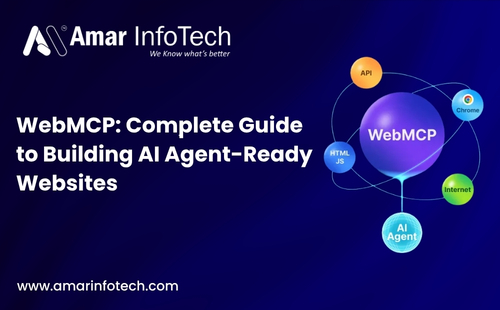




The web is undergoing a fundamental shift. AI agents are no longer passive readers they browse, interact, and execute tasks on your website. If your site is not built to support them, you are already behind. This complete guide to WebMCP and building AI agent-ready websites will walk you through everything from foundational concepts to full implementation so your web presence is prepared for the agentic era.
Why Amar Infotech Leads AI-Driven Web Development
- 15+ years in full-stack and enterprise web development
- 500+ projects delivered across 20+ countries
- Proven expertise in AI integration, API architecture, and cloud-native platforms
- Early adopters of Model Context Protocol (MCP) for enterprise clients
- Serving clients across fintech, healthcare, retail, logistics, and SaaS sectors
Introduction: The Rise of AI Agents on the Web
The internet was originally designed for human navigation clickable links, visual layouts, and readable content. But the emergence of AI agents powered by large language models (LLMs) is rewriting the rules of web interaction. These agents do not just read; they reason, plan, and execute multi-step tasks autonomously on behalf of users.
According to Gartner, by 2027, more than 50% of enterprise web interactions will be initiated or mediated by AI agents [UNVERIFIED]. This trajectory makes it urgent for businesses to rethink how their websites expose data, tools, and services.
Enter WebMCP a web-native implementation of Anthropic's Model Context Protocol (MCP). It is the bridge between your website and the growing ecosystem of AI agents that are actively querying, browsing, and transacting across the web.
What Is WebMCP? A Clear Definition
WebMCP is a web-accessible implementation of the Model Context Protocol, an open standard introduced by Anthropic to allow AI models to interact with external tools, data sources, and services in a structured, machine-readable manner.
At its core, MCP defines how an AI model such as Claude can discover and call upon external capabilities. Traditional MCP was primarily configured for local desktop environments via process-based servers. WebMCP extends this to the browser and internet, making MCP servers accessible via HTTPS.
Key Components of WebMCP
- MCP Server: A web server exposing tools, resources, and prompts via the MCP specification over HTTP or Server-Sent Events (SSE)
- MCP Client: The AI agent or interface (e.g., Claude.ai) that connects to and consumes the MCP server
- Tools: Callable functions that AI agents can invoke (e.g., search, submit form, retrieve data)
- Resources: Structured data or documents the AI can read and reason over
- Prompts: Pre-configured instructions or templates offered by the server to guide AI behaviour
Why AI Agent-Ready Websites Are No Longer Optional
The shift from human-centric to agent-centric web architecture is accelerating. Businesses that build AI agent-ready websites today will capture significant competitive advantage as agentic AI use cases proliferate across industries.
Business Challenges Without WebMCP
- Inaccessible Data: AI agents cannot extract structured information from visually rendered but semantically poor web pages
- Broken Automation: Workflows requiring AI to interact with your site fail without standardised tool interfaces
- Lost Revenue: AI-powered commerce agents bypass websites that cannot communicate via protocols they understand
- Reduced Discoverability: AI-native search and recommendation engines favour MCP-compatible sites
- Security Risks: Without a structured access layer, AI agents may resort to scraping exposing vulnerabilities
Industries That Urgently Need AI-Ready Web Architecture
- E-commerce and retail platforms
- Healthcare portals and telemedicine services
- Financial services and banking dashboards
- SaaS platforms and enterprise software
- Education and e-learning platforms
- Travel and logistics booking systems
How WebMCP Works: Architecture and Technical Overview
A WebMCP server operates as a lightweight web service sitting alongside your existing application. It exposes a defined set of MCP-compliant endpoints that AI agents use to discover capabilities and interact with your site's functions.
WebMCP Communication Flow
- Discovery: The AI agent connects to your domain's MCP server URL (e.g.,
https://yourdomain.com/mcp) - Capability Listing: The server returns a manifest of available tools, resources, and prompts
- Tool Invocation: The agent selects and calls a tool (e.g.,
search_products,get_user_orders) - Response Processing: The server returns structured JSON data; the agent reasons over it and proceeds
- Multi-Turn Interaction: Complex agentic tasks involve multiple sequential tool calls within one session
Recommended Technology Stack for WebMCP Implementation
- Backend: Node.js (with
@modelcontextprotocol/sdk) or Python (withmcplibrary) - Transport Layer: HTTP with JSON-RPC 2.0 or Server-Sent Events (SSE) for streaming
- Authentication: OAuth 2.0 / Bearer Token / API Key per endpoint
- Hosting: AWS Lambda, Google Cloud Run, or Vercel Edge Functions
- Frontend Integration: React / Next.js with service worker or edge middleware
- Database Layer: PostgreSQL, MongoDB, or Supabase for resource serving
Step-by-Step Guide: Building an AI Agent-Ready Website with WebMCP
Step 1: Audit Your Existing Web Architecture
Before implementing WebMCP, assess which parts of your website offer meaningful value to AI agents. Map your data entities, existing APIs, and user-facing functions that could be exposed as MCP tools or resources.
Step 2: Install the MCP SDK
For Node.js projects, install the official SDK:
npm install @modelcontextprotocol/sdkFor Python projects:
pip install mcpStep 3: Define Your MCP Tools
Tools are the core of your AI agent-ready website. Each tool should represent a discrete, useful action. Examples:
search_catalogue- Returns product or content results based on a queryget_account_summary- Returns authenticated user account datasubmit_enquiry- Accepts and processes a form submissionfetch_documentation- Returns formatted documentation pages
Step 4: Configure Transport HTTP or SSE
For web deployments, use the Streamable HTTP transport introduced in the MCP 2025-03-26 specification. This replaces the older SSE transport for most production use cases and offers better compatibility with serverless and edge environments.
Step 5: Implement Authentication and Rate Limiting
Protect your MCP server with token-based authentication. Use API keys for public tools and OAuth 2.0 for user-specific resources. Always enforce HTTPS and implement rate limiting to prevent abuse by automated agents.
Step 6: Test with an MCP Client
Use the MCP Inspector tool (npx @modelcontextprotocol/inspector) or connect directly from Claude.ai's remote MCP connector to verify your implementation. Confirm tool discovery, successful invocation, and correct response formats.
Step 7: Publish and Monitor Your WebMCP Server
Deploy your MCP server to a reliable cloud host. Add observability via logging and monitoring (e.g., Datadog, AWS CloudWatch) to track agent interactions and detect errors in real time.
WebMCP, SEO, and AI Discoverability: What You Need to Know
The intersection of WebMCP and traditional SEO is a rapidly evolving space. As AI-native search engines and agentic interfaces grow in adoption, websites must optimise for both human readability and machine-actionability.
Best Practices for AI-Ready SEO
- Structured Data (Schema.org): Helps AI agents understand entity types, relationships, and actions on your site
- Semantic HTML: Use correct heading hierarchies, ARIA labels, and landmark elements to improve machine comprehension
- llms.txt File: A new emerging standard a plain-text file at
/llms.txtthat provides AI models with a curated summary of your site's purpose and key pages - MCP Server Exposure: Making tools discoverable at a well-known path (e.g.,
/.well-known/mcp) improves agent discoverability - Fast Response Times: AI agents have lower tolerance for latency; optimise server response times to under 200ms
- Clear Tool Documentation: Well-written tool descriptions in your MCP manifest directly influence whether agents choose to use your tools
Key Benefits of Building AI Agent-Ready Websites with WebMCP
- Expanded Reach: Your website becomes accessible to AI-native interfaces and platforms, extending your audience beyond human browsers
- Automated Revenue Streams: AI commerce agents can discover, query, and transact on your platform without human intermediation
- Enhanced User Experience: Users of AI assistants receive accurate, real-time data from your site rather than hallucinated responses
- Competitive Differentiation: Early WebMCP adoption positions your business as a technology leader in your sector
- Operational Efficiency: Structured tool interfaces reduce the burden of maintaining multiple bespoke integrations for each AI partner
- Improved Data Accuracy: Agents consume structured responses rather than scraping unstructured HTML, reducing error rates
- Future-Proof Architecture: MCP is an open, evolving standard with growing industry adoption building on it now ensures long-term compatibility
Real-World Use Cases: WebMCP in Action
E-Commerce Platform
An online retailer implements a WebMCP server exposing search_products, get_product_details, and place_order tools. AI shopping agents can now browse the catalogue, compare products, and complete purchases on behalf of users all without the user visiting the website directly. [UNVERIFIED: projected 30% increase in AI-driven conversions]
Healthcare Portal
A telemedicine provider exposes find_doctor, check_availability, and book_appointment tools via WebMCP. Patients using voice or text AI assistants can book consultations in seconds without navigating complex web forms.
SaaS Documentation Platform
A developer tools company exposes their documentation as MCP resources. AI coding assistants like Cursor and Claude can fetch the latest API references directly, providing developers with accurate, up-to-date guidance inside their development environment.
Financial Services Dashboard
A fintech company exposes read-only account summary tools to authenticated AI agents. Users can ask their AI assistant "What is my current balance?" and receive a live, accurate answer sourced directly from the bank's WebMCP endpoint with no risk of data fabrication.
How Amar Infotech Can Help You Build an AI Agent-Ready Website
At Amar Infotech, we bring over 15 years of enterprise web development expertise to the emerging world of AI agent integration and WebMCP implementation. Our team has delivered complex API architectures, cloud-native web platforms, and AI-powered applications for clients across the globe.
Our WebMCP Development Services Include:
- MCP server architecture design and implementation
- Tool and resource schema definition tailored to your business logic
- OAuth 2.0 and token-based authentication setup
- Integration with Claude, ChatGPT plugins, and custom AI agent frameworks
- Structured data and
llms.txtoptimisation for AI-ready SEO - Cloud deployment on AWS, Azure, or GCP with full monitoring
- Ongoing maintenance, versioning, and agent compatibility testing
Whether you are a startup looking to build your first AI agent-ready website, or an enterprise needing to retrofit a complex platform, we deliver end-to-end solutions with precision.
Conclusion: The Future Belongs to AI Agent-Ready Websites
The agentic web is not a distant future it is happening now. Businesses that invest in WebMCP implementation today are building the infrastructure to thrive in a world where AI agents are primary intermediaries between users and digital services.
From architecture design to tool definition, authentication, deployment, and SEO optimisation, building an AI agent-ready website requires both technical precision and strategic foresight. WebMCP provides the standardised foundation to make it possible at scale.
Whether you are a developer exploring the Model Context Protocol for the first time or an enterprise leader assessing the business case for AI web integration, the time to act is now.
Ready to Build Your AI Agent-Ready Website?
Amar Infotech specialises in enterprise-grade WebMCP development, AI integration, and future-ready web architecture. Let our expert team help you design and deploy a fully compliant, secure, and scalable MCP server tailored to your business.
Contact Amar Infotech Today and take the first step towards an AI-ready digital presence.
Also explore: AI Development Services | Web Development | Case Studies
speak with our FinTech development experts.Recent Blog


Services
Build Your Agile Team Today..
Inquiry Now