



Why Mobile Payments in Africa Matter for Your Business Strategy
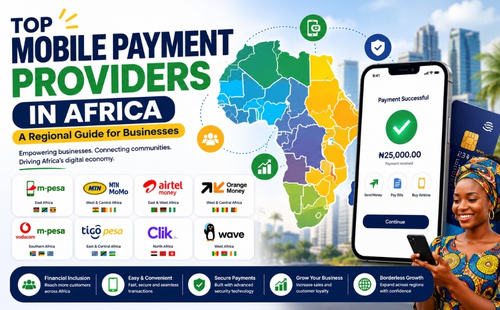
Africa is undergoing one of the most remarkable financial revolutions in modern history. With over 1.4 billion people and mobile phone penetration surpassing traditional banking infrastructure in many regions, mobile payment providers in Africa have become the backbone of commerce from street-level retail to cross-border enterprise transactions.
According to the GSMA Mobile Economy Sub-Saharan Africa, the continent accounts for more than 70% of the world's mobile money transactions by value. For businesses seeking to expand into or operate across African markets, selecting the right digital payment platform in Africa is not a secondary concern it is a foundational commercial decision.
This regional guide examines the top mobile payment providers across Africa, their coverage, capabilities, integration options, and suitability for different business models. Whether you are building an e-commerce platform, a logistics application, or a B2B payment system, this guide will help you make an informed decision.
The African Mobile Payment Market : Key Statistics and Business Context
The African fintech market is projected to exceed USD 65 billion by 2030, according to McKinsey & Company [UNVERIFIED cite upon publication verification]. Mobile money accounts for a dominant share of this growth, driven by high smartphone adoption, young demographics, and a large unbanked population estimated at over 350 million adults [World Bank, Global Findex 2021].
Key market characteristics businesses must understand:
- Regional Fragmentation: Payment preferences vary significantly between East, West, Southern, and North Africa.
- Regulatory Diversity: Each country maintains independent financial regulations governed by national central banks.
- Multi-Currency Complexity: Over 40 currencies are in active use across the continent.
- USSD Dominance in Rural Areas: Many users transact via USSD codes rather than smartphone apps, making network-independent solutions critical.
- Growing API Ecosystem: Fintech infrastructure is maturing rapidly, with robust REST API ecosystems from leading providers.
Top Mobile Payment Providers in Africa by Region
1. M-Pesa East - Africa's Dominant Mobile Money Network
- Coverage: Kenya, Tanzania, Ethiopia, Ghana, Egypt, Mozambique, DRC, Lesotho
- Operator: Safaricom / Vodacom
- Best For: Peer-to-peer transfers, bill payments, merchant payments, salary disbursements
- Business Integration: M-Pesa Daraja API (REST) supports C2B, B2C, B2B, and STK Push
- Transaction Volume: Over 60 billion USD in annual transactions (Kenya alone) [GSMA, 2024]
M-Pesa is undisputedly the most recognisable mobile payment provider in Africa. Launched in Kenya in 2007 by Safaricom, it has grown into a comprehensive financial ecosystem offering savings, credit, insurance, and international transfers. For businesses operating in East Africa, M-Pesa integration is not optional it is essential.
The Daraja API enables developers to integrate M-Pesa directly into web and mobile applications, supporting automated payment collection, instant disbursements, and real-time transaction notifications.
2. Flutterwave - Pan-African Payment Infrastructure
- Coverage: 34+ African countries including Nigeria, Ghana, Kenya, South Africa, Rwanda, Uganda
- Headquarters: San Francisco, USA (African operations hub: Lagos, Nigeria)
- Best For: E-commerce, cross-border payments, payment links, marketplace platforms
- Business Integration: REST API, hosted payment page (Rave), SDKs for Android, iOS, JavaScript
- Valuation: Unicorn status valued at over 3 billion USD [UNVERIFIED]
Flutterwave has positioned itself as the premier African digital payment platform for businesses that require broad regional reach. Its infrastructure supports over 150 currencies, accepts cards, bank transfers, mobile money, and USSD, making it uniquely suited for businesses targeting multiple African markets simultaneously.
For enterprises and startups building pan-African e-commerce or SaaS platforms, Flutterwave's Payment Links and Storefront features allow rapid go-to-market without deep custom development.
3. Paystack - Nigeria's Leading Online Payment Gateway
- Coverage: Nigeria, Ghana, South Africa, Kenya, Côte d'Ivoire, Rwanda, Egypt
- Parent Company: Stripe (acquired 2020)
- Best For: SMEs, subscription billing, online retail, developer-first integrations
- Business Integration: REST API, plugins for WooCommerce, Shopify, Magento, Squarespace
Paystack is widely regarded as the most developer-friendly mobile payment solution in West Africa. Its clean API documentation, sandbox environment, and plug-and-play e-commerce integrations make it the go-to choice for Nigerian startups and SMEs. Since its acquisition by Stripe, Paystack has benefited from global infrastructure, enhancing reliability and compliance capabilities.
Businesses seeking to launch quickly in Nigeria or Ghana without extensive payment infrastructure should strongly consider Paystack as their primary online payment gateway in Africa.
4. DPO Group (Network International) - Southern and East Africa
- Coverage: 54 African countries
- Best For: Travel, hospitality, NGOs, enterprise merchants
- Business Integration: Hosted payment page, REST API, virtual terminal
- Key Feature: Multi-currency support across 54 nations from a single account
DPO Group, now part of Network International, is the broadest-reach payment processor in Africa by country coverage. It is particularly valuable for businesses in the travel, tourism, and hospitality sectors that require a unified payment solution across diverse African markets. Its virtual terminal also supports offline and telephone-order payment processing.
5. Chipper Cash - Cross-Border Mobile Payments for African Consumers and Businesses
- Coverage: Nigeria, Ghana, Kenya, Tanzania, Uganda, Rwanda, South Africa, UK, USA
- Best For: Freelancers, remittances, cross-border B2B payments, SME payables
- Business Integration: Chipper Business API for bulk payments and collections
Chipper Cash has rapidly gained traction as a go-to platform for cross-border mobile payments within Africa. It enables fee-free or low-fee transfers across currencies and borders a significant value proposition in a continent where cross-border transfer fees have historically exceeded 7–10% per transaction [World Bank Remittance Prices Worldwide, 2024].
6. Orange Money - Francophone and Central Africa
- Coverage: Senegal, Côte d'Ivoire, Mali, Cameroon, Burkina Faso, Guinea, Madagascar, DRC
- Operator: Orange Telecom Group
- Best For: Retail merchant payments, utility bills, salary disbursements in Francophone markets
- Business Integration: Orange Money Business API, USSD-based payment initiation
For businesses entering Francophone African markets, Orange Money is the dominant mobile wallet and cannot be overlooked. With deep telco infrastructure and significant brand trust across West and Central Africa, Orange Money serves millions of unbanked users who primarily transact via USSD rather than internet-based applications.
7. SnapScan & Zapper - QR-Based Payments for South Africa
- Coverage: South Africa (primary)
- Best For: In-store QR payments, restaurant and retail point-of-sale
- Business Integration: Merchant API, QR code generation, POS system integration
South Africa operates a more mature and bank-integrated digital payments ecosystem compared to other African regions. SnapScan (Standard Bank) and Zapper are leading QR-code-based mobile payment solutions in South Africa, widely accepted at retailers, restaurants, and service providers across the country.
How to Choose the Right Mobile Payment Provider in Africa for Your Business
Selecting the optimal African payment platform requires a structured evaluation framework. Avoid defaulting to the most popular name align your selection with your specific geography, customer base, transaction volume, and technical infrastructure.
Key Evaluation Criteria
- Geographic Coverage: Does the provider operate in your target country or region? A provider dominant in Nigeria may have limited presence in the DRC.
- Payment Method Support: Can the platform accept mobile wallets, bank transfers, cards, and USSD? Multi-method support is critical in markets with diverse user behaviour.
- API Quality and Documentation: Evaluate sandbox environments, webhook support, SDK availability, and developer community strength.
- Transaction Fees: Compare flat-rate vs percentage-based models. For high-volume businesses, fee structures significantly impact margins.
- Regulatory Compliance: Ensure the provider is licensed by the relevant central bank and adheres to PCI DSS and local AML/KYC requirements.
- Settlement Currency and Speed: Evaluate how quickly funds are settled and whether settlements are made in local or international currency.
- Customer Support: For enterprise deployments, dedicated support, SLAs, and uptime guarantees are non-negotiable.
Technical Integration of African Mobile Payment APIs into Your Platform
Integrating a mobile payment API in Africa follows standard REST principles, but each provider has unique authentication models, webhook structures, and testing environments. Below is a generalised technical integration pathway applicable to providers including Flutterwave, Paystack, and M-Pesa Daraja.
Standard Integration Architecture
- Frontend: React / Angular / Vue.js - Payment UI, payment button, redirect handling
- Backend: Node.js / Python (Django/Flask) / .NET - API key management, payment initiation, webhook validation
- Database: PostgreSQL / MongoDB - Transaction records, reconciliation logs
- Security Layer: HTTPS, HMAC signature verification for webhooks, IP whitelisting
- Webhook Handler: Real-time payment status updates - success, failure, pending
- Testing: Sandbox environments provided by all major providers
For businesses building mobile payment integrations in Africa across multiple providers simultaneously, a payment orchestration layer (such as Mono or Bloc in Nigeria) can abstract provider differences and enable failover routing.
Amar Infotech's Mobile App Development and Web Development teams have deep experience building custom payment integrations for African and global markets, including multi-provider orchestration, PCI DSS compliance, and real-time reconciliation systems.
Business Challenges When Implementing Digital Payments in Africa
Despite the immense opportunity, businesses must anticipate and mitigate several operational and regulatory challenges when deploying mobile payment solutions across Africa:
- Regulatory Fragmentation: Licensing requirements differ per country. Operating in five African nations may require five separate regulatory engagements.
- Currency Volatility: Several African currencies experience significant exchange rate volatility, impacting cross-border revenue predictability.
- Connectivity Gaps: Rural markets still face intermittent internet and data connectivity, requiring USSD fallback solutions.
- Fraud and Chargebacks: Card fraud rates in some African markets are higher than global averages. Providers with strong fraud detection systems (3DS2, velocity checks) should be prioritised.
- Settlement Delays: Some providers settle in T+1 or T+3 cycles, which can create working capital challenges for SMEs.
- Consumer Trust Barriers: First-time digital payment users in some markets may require additional UX simplification and localised customer education.
How Amar Infotech Supports African Fintech and Payment Integration Projects
At Amar Infotech, we have delivered payment integration and fintech platform development projects for clients across Africa, Asia, and Europe. Our engineering teams specialise in:
- Custom Payment Gateway Integration: M-Pesa Daraja API, Flutterwave, Paystack, DPO Group, and emerging African payment providers.
- Mobile App Development: Android and iOS applications with embedded African mobile payment solutions, biometric authentication, and offline transaction queuing.
- E-Commerce Platform Development: WooCommerce, custom React storefronts, and headless commerce platforms with multi-provider payment support.
- AI-Powered Fraud Detection: Machine learning models integrated with payment pipelines to detect anomalous transactions in real time. See our AI Development Services.
- ERP and Accounting Integration: Automated reconciliation between payment providers and ERP systems (SAP, Odoo, QuickBooks).
- Compliance and Security Audits: PCI DSS readiness assessments, AML/KYC workflow design, and data protection compliance for African regulatory environments.
Explore our case studies to see how we have delivered fintech and payment integration solutions for businesses in emerging markets.
Conclusion: Building a Winning Mobile Payment Strategy in Africa
Africa's mobile payment ecosystem is no longer nascent it is mature, complex, and commercially critical. From M-Pesa's dominance in East Africa to Flutterwave and Paystack's grip on West Africa, and from Orange Money's Francophone reach to DPO's continent-wide enterprise coverage, the right provider depends entirely on your geography, user base, and technical requirements.
Businesses that approach African digital payments with a regionally informed, technically rigorous strategy will outperform those that apply a one-size-fits-all approach. Invest in understanding local payment behaviour, prioritise API-first integration, and build compliance into your architecture from day one.
The opportunity is significant. The execution must be precise.
Ready to Integrate African Mobile Payment Solutions into Your Platform?
Amar Infotech specialises in end-to-end fintech development, payment gateway integration, and mobile app engineering for African and global markets. Whether you need an M-Pesa integration, a Flutterwave-powered marketplace, or a custom multi-provider payment orchestration layer our team can deliver.
Contact Amar Infotech Let's Build Your African Payment Infrastructure
Related Services & Resources
- Mobile App Development Services
- Web Development Services
- AI & Machine Learning Development
- IoT Application Development
- Client Case Studies
- Contact Amar Infotech
Recent Blog

Services
Build Your Agile Team Today..
Inquiry Now